
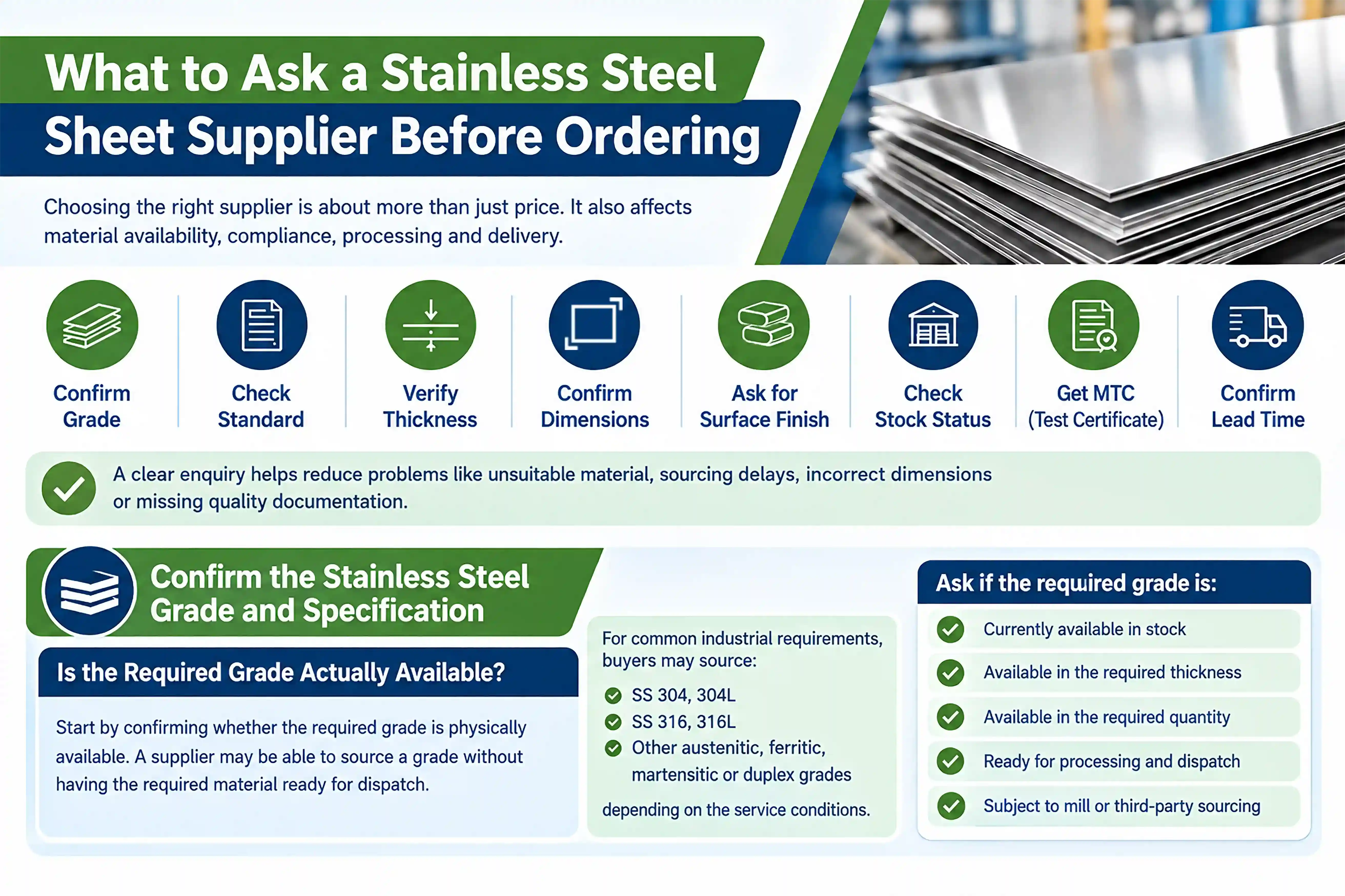
Choosing a stainless steel sheet supplier is about more than comparing prices. For procurement teams, fabricators, OEMs and project buyers, the supplier also affects material availability, specification compliance, documentation, processing and delivery schedules.
Before ordering, confirm the stainless steel grade, applicable standard, thickness, dimensions, surface finish, stock status, MTC and lead time. A clear enquiry helps reduce problems such as unsuitable material, unexpected sourcing delays, incorrect dimensions or missing quality documentation.
Start by confirming whether the required stainless steel grade is physically available. A supplier may be able to source a grade without having the required material ready for dispatch.
For common industrial requirements, buyers may source SS 304, 304L, SS 316, 316L and other austenitic, ferritic, martensitic or duplex grades depending on the service conditions.
Ask whether the required grade is:
This distinction is important when the material is required for a fabrication schedule or time-sensitive project.
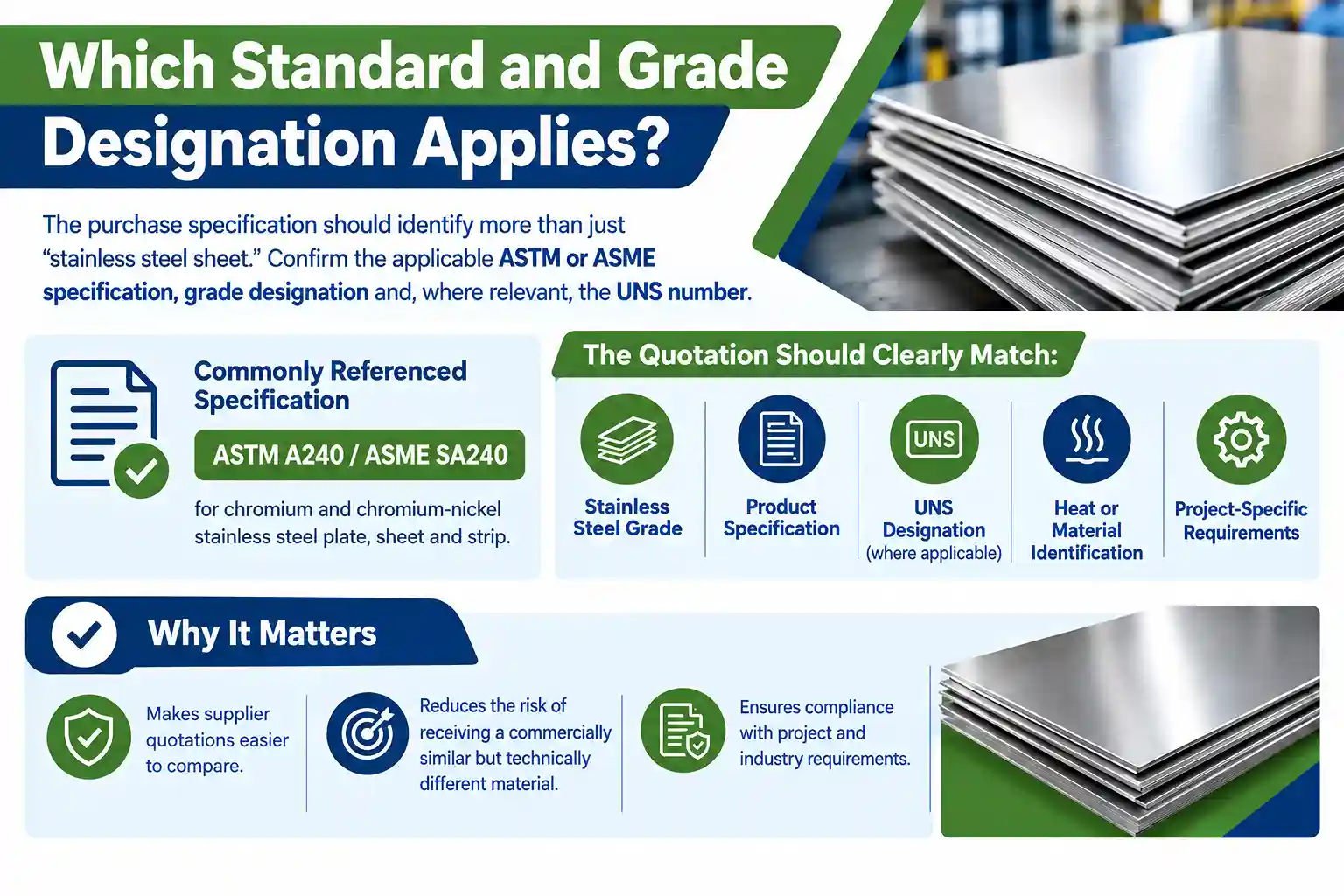
The purchase specification should identify more than just "stainless steel sheet."
Confirm the applicable ASTM or ASME specification, grade designation and, where relevant, the UNS number. For stainless steel sheet and plate, ASTM A240 / ASME SA240 is commonly referenced for chromium and chromium-nickel stainless steel plate, sheet and strip.
The quotation should clearly match the required:
This makes supplier quotations easier to compare and reduces the possibility of receiving a commercially similar but technically different material.
Grade selection should reflect the environment in which the sheet will be used.
304/304L is widely used where its corrosion resistance, formability and fabrication characteristics are suitable. 316/316L, with molybdenum addition, is often considered where greater resistance to chloride-related localized corrosion is required.
The supplier should be given relevant application information where it affects material selection, such as chemical exposure, marine conditions, operating temperature, welding or fabrication requirements.
A stainless steel sheet requirement is incomplete without dimensions.
Specify the required thickness, width, length and quantity, along with any important dimensional tolerances or flatness requirements.
Buyers should also confirm whether the requested dimensions are:
For example, confirming that 316 stainless steel is available does not necessarily mean that the required 6 mm × 1500 mm × 3000 mm sheets are immediately available.
For available grades, dimensions, thicknesses and finishes, buyers can review Siddhgiri Overseas' stainless steel sheets and plates range when preparing their requirement.
Surface finish should be specified during the enquiry rather than left open to interpretation.
Depending on the product and application, stainless steel sheets may be supplied with finishes such as 2B, 2D, BA, No. 4/brushed or hot-rolled finishes.
The appropriate finish can depend on the appearance required, fabrication process, cleaning requirements and final service conditions.
For architectural, food-processing or visible fabricated components, surface condition may be particularly important. Industrial components that undergo further fabrication may have different finish requirements.
If the project requires custom dimensions, ask whether the supplier can provide the sheets in the required finished size.
The enquiry should clarify:
Receiving cut-to-size material can reduce secondary handling and fabrication work, but processing requirements should be confirmed before the order is finalized.
For industrial and project procurement, documentation can be just as important as the physical material.
Ask whether the supplier can provide a Mill Test Certificate (MTC) or other documentation required by the purchase specification.
Depending on the material and project, documentation may identify:
Confirm documentation requirements before ordering, particularly when the material will undergo incoming inspection or form part of a project quality dossier.
Heat number traceability connects the supplied material with its manufacturing and test records.
This can be important for EPC projects, OEM production, regulated applications and quality audits where the buyer needs to demonstrate that the material supplied corresponds with its certificate.
Ask how the supplier maintains identification between the sheets, heat number and supporting documentation throughout storage, cutting and dispatch.
When the sheets arrive, the buyer should verify that the delivered material corresponds with the purchase order.
Basic checks can include:
Any project-specific inspection, testing or acceptance criteria should be established before delivery rather than after a discrepancy is discovered.
Lead time can mean different things depending on how the material is being supplied.
For ready-stock material, the process may be relatively straightforward:
Stock → inspection/processing → packing → dispatch → transportation
Material that needs to be sourced or produced can involve additional stages:
Sourcing → production → inspection → processing → documentation → packing → dispatch
Therefore, ask whether the quoted lead time is based on material already in stock or material that still needs to be sourced.
This is particularly important when stainless steel sheets are required for an active fabrication or project schedule.
The final delivery date can depend on more than transportation.
Potential factors include:
A supplier should be able to explain which parts of the order are already available and which require additional processing or sourcing.
Stainless steel sheets should be packed and handled appropriately to help protect their surface and edges during transportation.
Depending on the shipment and destination, buyers may need to clarify surface protection, edge protection, sheet identification, securing and export packaging requirements.
This becomes increasingly important when material is being transported over long distances or shipped internationally.
A detailed Request for Quotation (RFQ) gives the supplier enough information to identify the material and prepare a more accurate quotation.
| Requirement | What to Specify |
|---|---|
| Grade | SS 304, 304L, 316, 316L, etc. |
| Standard | ASTM A240 / ASME SA240 or project specification |
| Thickness | Required thickness |
| Dimensions | Width × length |
| Finish | 2B, BA, No. 4, HR, etc. |
| Quantity | Required quantity |
| Processing | Full sheet or cut-to-size |
| Documentation | MTC / inspection requirements |
| Destination | Delivery location or country |
| Application | Intended use where relevant |
Providing these details at the beginning reduces unnecessary back-and-forth and allows suppliers to confirm availability, specification, processing requirements and lead time more accurately.
A complete enquiry allows the supplier to quote against the actual requirement instead of making assumptions.
It also helps procurement teams compare quotations on the same basis. Two suppliers may quote the same stainless steel grade but differ in thickness availability, surface finish, processing, documentation, lead time or delivered condition.
A clear RFQ therefore makes the commercial comparison more meaningful.
Price is important, but it should not be the only factor.
Compare the complete supply package, including:
Material specification + availability + dimensions + finish + processing + documentation + lead time + delivered cost
This gives a better picture of the actual procurement value than comparing only the quoted price per kilogram or sheet.
A reliable stainless steel sheet supplier should be able to clearly communicate the material specification, stock position, dimensions, finish, documentation, traceability and expected delivery schedule.
For buyers sourcing SS 304, SS 316 and other stainless steel grades, Siddhgiri Overseas supplies stainless steel sheets and plates in multiple grades, thicknesses, sizes and finishes for industrial and project requirements.
When requesting a quotation, provide the required grade, standard, thickness, dimensions, finish, quantity, destination and documentation requirements. This gives the supplier a clear understanding of the requirement and helps establish whether the proposed material is suitable for the intended purchase.