
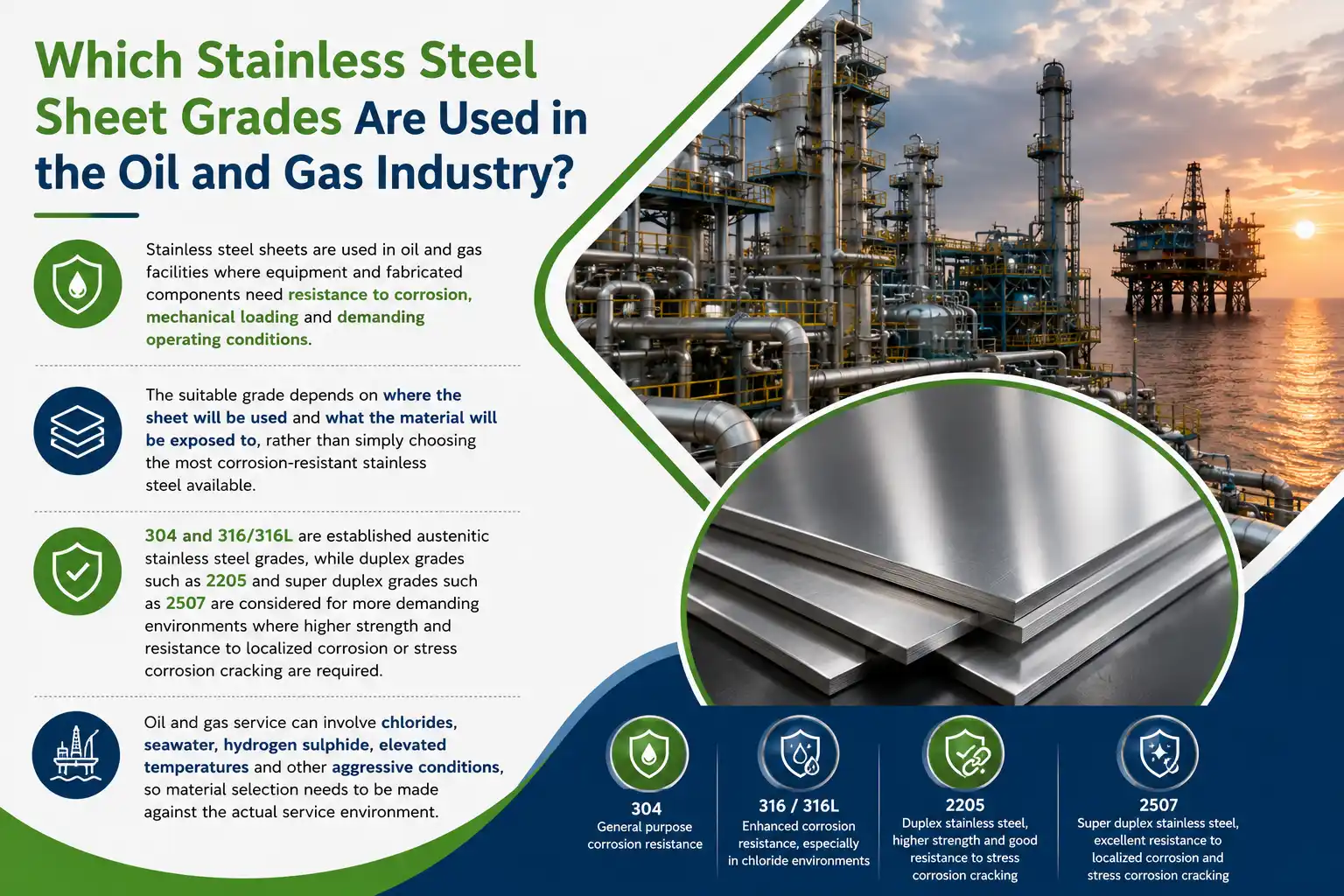
Stainless steel sheets are used in oil and gas facilities where equipment and fabricated components need resistance to corrosion, mechanical loading and demanding operating conditions. The suitable grade depends on where the sheet will be used and what the material will be exposed to, rather than simply choosing the most corrosion-resistant stainless steel available.
304 and 316/316L are established austenitic stainless steel grades, while duplex grades such as 2205 and super duplex grades such as 2507 are considered for more demanding environments where higher strength and resistance to localized corrosion or stress corrosion cracking are required. Oil and gas service can involve chlorides, seawater, hydrogen sulphide, elevated temperatures and other aggressive conditions, so material selection needs to be made against the actual service environment.
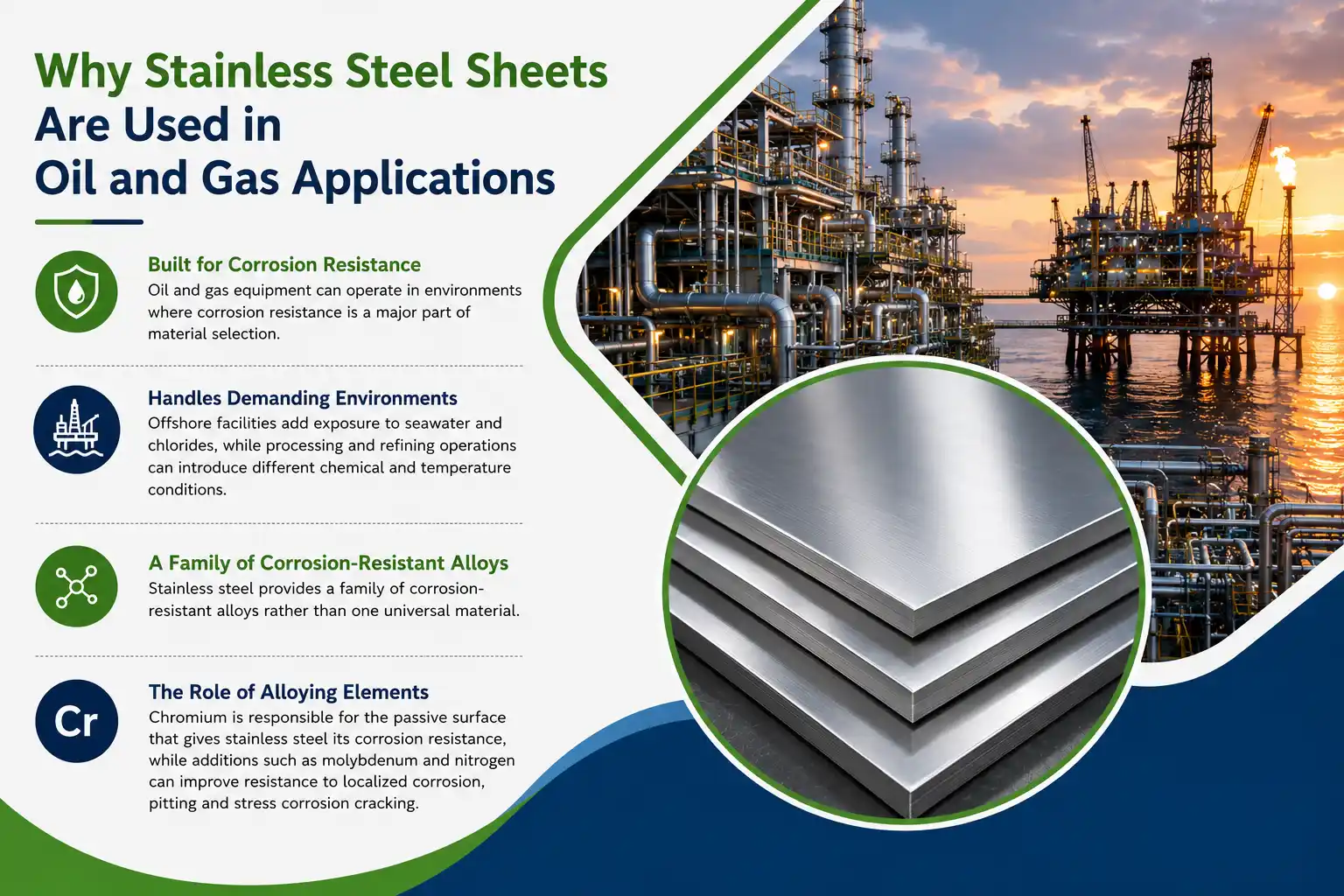
Oil and gas equipment can operate in environments where corrosion resistance is a major part of material selection. Offshore facilities add exposure to seawater and chlorides, while processing and refining operations can introduce different chemical and temperature conditions.
Stainless steel provides a family of corrosion-resistant alloys rather than one universal material. Chromium is responsible for the passive surface that gives stainless steel its corrosion resistance, while additions such as molybdenum and nitrogen can improve resistance to localized corrosion. The choice of grade therefore changes with the severity of the service environment.
For offshore and subsea applications, this distinction becomes particularly important. Industry guidance identifies duplex stainless steels in applications including process piping, pumps, valves, separator vessels, manifolds, seawater systems, flowlines and risers.
The grade should be selected from the conditions the material will actually experience. A sheet used for an indoor fabricated component in a relatively mild environment may have very different requirements from material exposed to seawater, chlorides or sour service.
Important considerations include:
The same approach is reflected in oil and gas materials standards. NORSOK M-001 is specifically a materials-selection standard for petroleum applications, while API standards include dedicated requirements and guidance for duplex stainless steels in chemical, oil and gas applications.
304 stainless steel is one of the most widely used austenitic stainless steel grades, but it should not be treated as a universal oil and gas material.
Its combination of corrosion resistance, formability and fabrication characteristics makes it useful in many industrial applications. In petroleum refining, Type 304 has been used for components such as fractionator trays and smaller fittings, with the actual grade depending on the process environment and corrosion conditions.
304L is the low-carbon version commonly selected where its welding characteristics and resistance to sensitization after welding are important. For fabricated sheet components, the choice between 304 and 304L therefore needs to consider the fabrication method and applicable material specification.
Where the service environment contains significant chlorides or presents a higher localized-corrosion risk, a higher-alloy grade may be more appropriate than 304.
316 and 316L contain molybdenum, which gives them greater resistance to chloride-related localized corrosion than 304. This is one reason 316L has an established history in oil and gas applications.
Outokumpu's oil and gas material guidance identifies 316L as the first stainless steel grade used in the oil and gas industry and notes that it has increasingly been replaced in some applications by duplex and superaustenitic grades as service requirements have become more demanding.
The distinction is important: 316L can be an appropriate choice for many industrial and oil and gas applications, but it does not automatically provide sufficient resistance for every offshore, subsea or high-chloride environment.
For applications involving more severe chloride exposure or higher mechanical requirements, duplex stainless steel can offer a different balance of properties.
Duplex stainless steels combine austenitic and ferritic phases, giving them a combination of corrosion resistance and higher strength than conventional austenitic grades.
2205 duplex stainless steel is one of the most widely used duplex grades. It is associated with applications where 316/316L does not provide enough corrosion resistance, and it is used in offshore oil and gas, chemical processing and other demanding environments. BSSA describes 2205 as a grade that combines high strength with strong resistance to pitting, crevice corrosion and stress corrosion cracking.
The oil and gas industry uses duplex grades across a range of equipment. World Stainless identifies 2205 and superduplex grades for applications such as process piping, pumps, valves, separator vessels, manifolds, seawater piping and subsea flowlines.
This higher performance can also affect sheet thickness and equipment design. Duplex stainless steels have substantially higher design strength than conventional austenitic grades, which can allow thinner sections in suitable designs. The actual thickness, however, must be determined from the applicable design code and service requirements rather than from grade selection alone.
Some oil and gas environments place even greater demands on corrosion resistance and mechanical performance. Offshore and subsea systems can be exposed to seawater, chlorides, high pressures and other conditions that push conventional stainless steel grades beyond their practical limits.
Super duplex grades such as 2507 (UNS S32750) provide higher alloy content and greater resistance to localized corrosion than standard duplex grades. Industry references identify superduplex grades in oil and gas applications including topside construction, separators, process piping, umbilicals and flexible pipes.
For some oil and gas specifications, PREN is also used as part of corrosion-resistance assessment. BSSA notes that oil and gas specifications such as NORSOK or NACE can require minimum PREN levels for superduplex materials.
That does not mean a higher PREN automatically makes a grade suitable for every application. Material selection still needs to consider the complete service environment, applicable standards and project requirements.
The practical choice usually comes down to matching the sheet grade to the service conditions rather than ranking grades from "good" to "best."
For relatively moderate industrial conditions, 304 or 304L may be suitable where the project specification permits it. Where chloride exposure or corrosion severity increases, 316/316L may provide a more appropriate level of resistance. For more demanding offshore, subsea or chloride-containing environments, duplex 2205 or super duplex grades may be specified because they combine higher strength with improved resistance to localized corrosion and stress corrosion cracking.
Sour-service applications require additional attention. Hydrogen sulphide can affect material selection and cracking resistance, and standards such as NACE MR0175/ISO 15156 establish material and environmental limits for equipment used in oil and gas production.
Once the grade has been established, the sheet specification needs to be defined around the actual fabrication and project requirements.
Procurement specifications may include:
For duplex and other higher-alloy materials, this documentation becomes particularly important because material condition, fabrication and heat treatment can influence the expected corrosion resistance and mechanical properties. Nickel Institute guidance notes that duplex mill products need appropriate control of detrimental secondary phases so that fabrication can achieve the intended properties.
There is no single stainless steel sheet grade that fits every oil and gas application. 304/304L, 316/316L, 2205 duplex and 2507 super duplex each occupy different positions in the material-selection process.
The right choice depends on the service environment, corrosion mechanism, temperature, mechanical requirements, fabrication process and applicable project specification. Once those requirements are established, the sheet can be specified by grade, thickness, dimensions, finish and required documentation.
Siddhgiri Overseas supplies stainless steel sheets and plates in multiple grades, sizes, thicknesses and finishes for industrial fabrication and project requirements. For oil and gas applications, buyers can specify the required grade, dimensions, finish, quantity and documentation requirements so that the material can be matched to the intended application.