
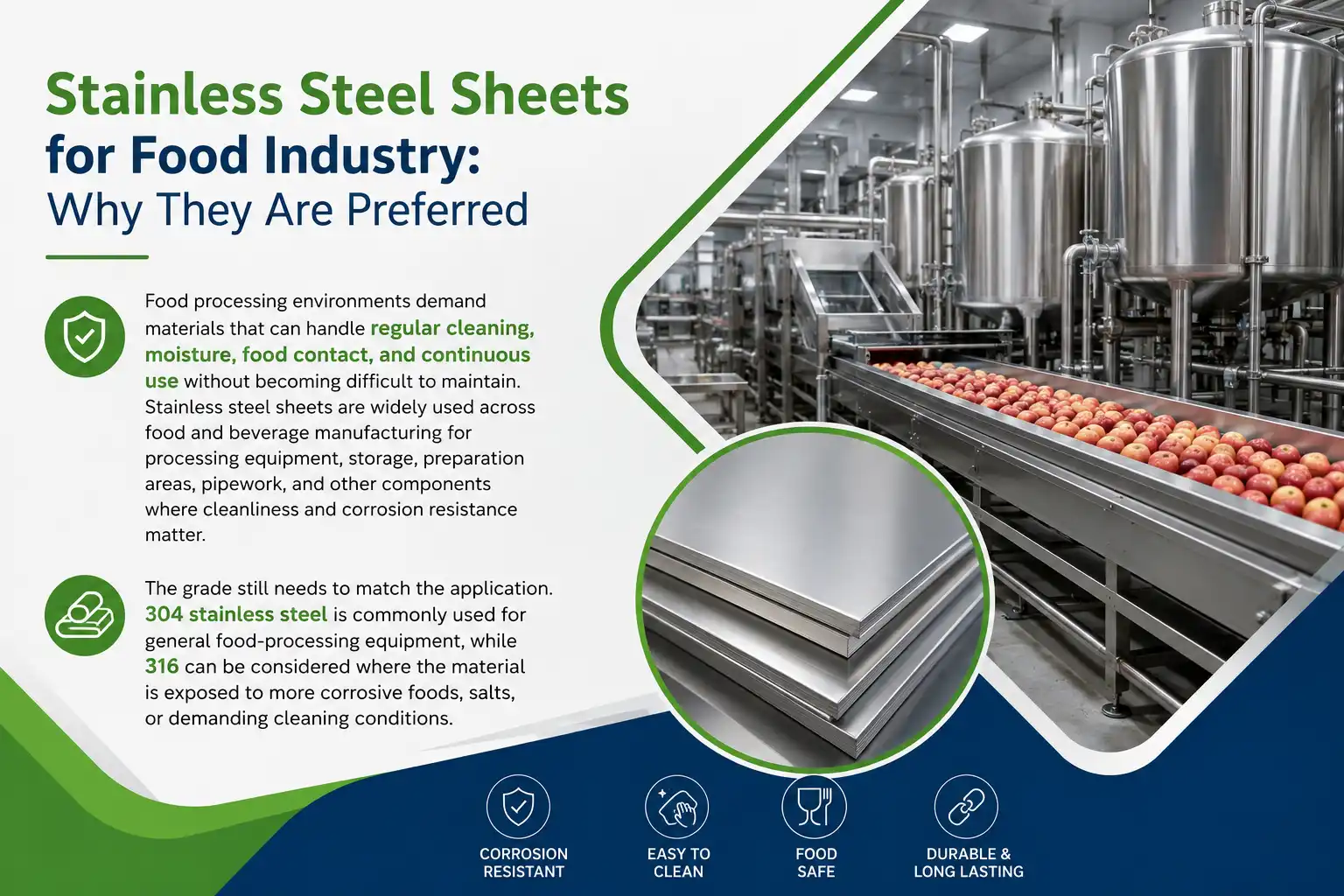
Food processing environments demand materials that can handle regular cleaning, moisture, food contact, and continuous use without becoming difficult to maintain. Stainless steel sheets are widely used across food and beverage manufacturing for processing equipment, storage, preparation areas, pipework, and other components where cleanliness and corrosion resistance matter.
The grade still needs to match the application. 304 stainless steel is commonly used for general food-processing equipment, while 316 can be considered where the material is exposed to more corrosive foods, salts, or demanding cleaning conditions.
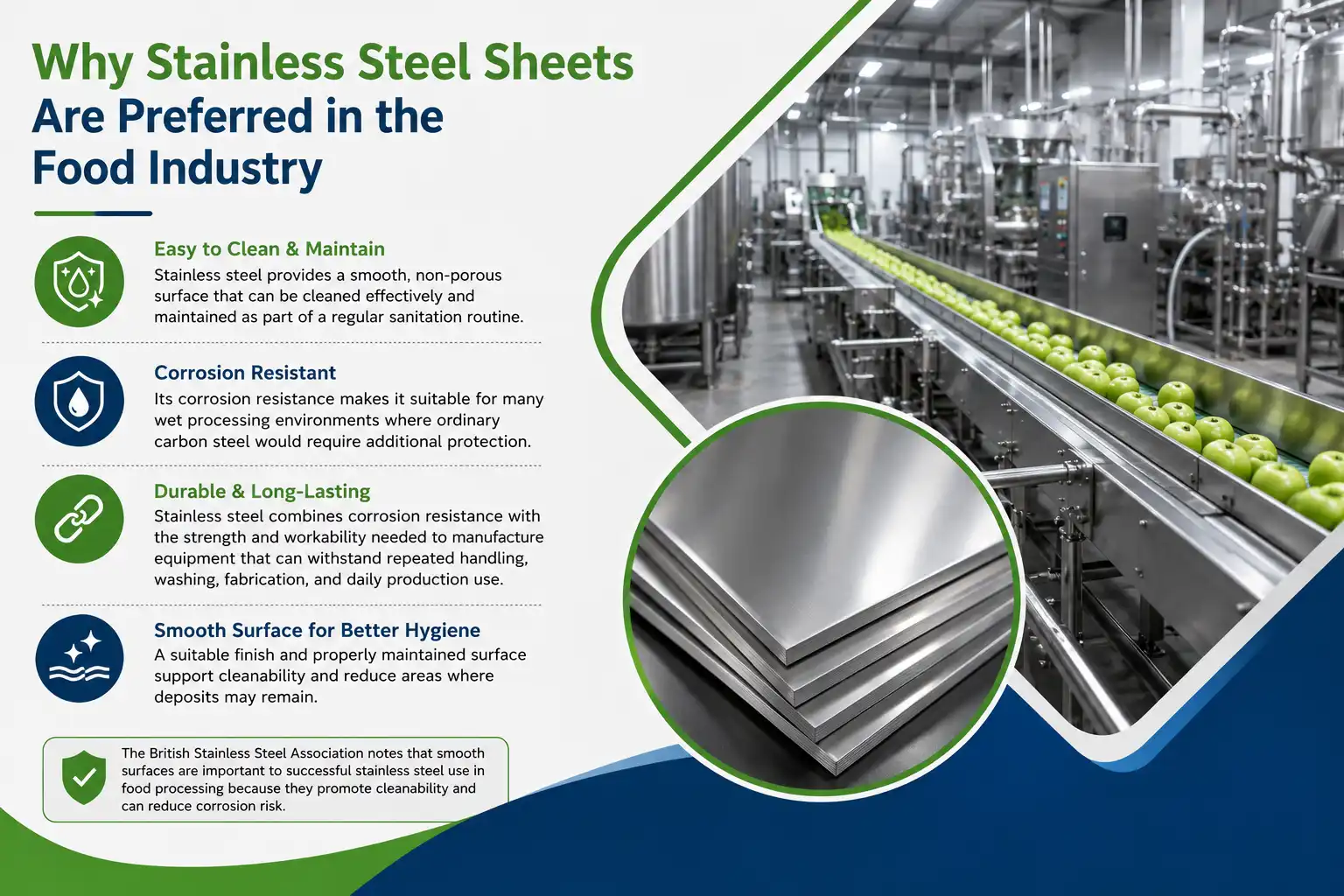
Food-processing equipment is cleaned frequently, exposed to water and food residues, and often operates for long periods. The material used in these areas therefore needs to do more than simply look clean.
Stainless steel provides a smooth, non-porous surface that can be cleaned effectively and maintained as part of a regular sanitation routine. Its corrosion resistance also makes it suitable for many wet processing environments where ordinary carbon steel would require additional protection.
Another advantage is its durability. Processing equipment, preparation surfaces, storage vessels, and other components can see repeated handling, washing, fabrication, and daily production use. Stainless steel combines corrosion resistance with the strength and workability needed to manufacture these components.
Surface condition is also important. A suitable finish and properly maintained surface can support cleanability and reduce areas where deposits may remain. The British Stainless Steel Association notes that smooth surfaces are important to successful stainless steel use in food processing because they promote cleanability and can reduce corrosion risk.
Stainless steel sheets can be found throughout food manufacturing facilities, from preparation areas to processing and storage equipment. The exact application depends on the type of food being handled and the conditions the equipment will experience.
Preparation and processing equipment needs surfaces that can withstand repeated contact with food ingredients and regular cleaning. Stainless steel sheets are used to fabricate equipment components, work surfaces, vessels, and machinery parts used in these operations.
304 stainless steel is particularly common for equipment requiring a combination of corrosion resistance, formability, and weldability. Typical applications include vats, bowls, pipework, and machinery components.
Tanks and vessels used for food ingredients, liquids, and processed products need to remain resistant to moisture and the substances being stored or processed.
Stainless steel sheets can be fabricated into tanks, vessels, and related components for applications across food and beverage production. Their corrosion resistance helps the equipment remain suitable for repeated processing and cleaning cycles.
Preparation tables, counters, equipment panels, and similar surfaces are exposed to food residues, water, utensils, and frequent cleaning.
Stainless steel is well suited to these areas because it provides a durable working surface that can be cleaned repeatedly without relying on paint or other surface coatings for basic corrosion protection. In commercial foodservice environments, stainless steel sheets are also widely used for preparation surfaces, sinks, storage systems, backsplashes, and other kitchen components.
Food-processing machinery often contains several fabricated components that need to withstand continuous operation and regular sanitation.
Stainless steel sheets can be formed and fabricated into hoppers, panels, guards, chutes, conveyor components, and other equipment parts. The choice of grade depends on the food product, cleaning chemicals, temperature, moisture, and the mechanical requirements of the component.
Washing areas are particularly demanding because the material may be exposed to water, detergents, food residues, and repeated cleaning.
Stainless steel sheets are commonly used for sinks, drainboards, washing stations, and surrounding surfaces. Their corrosion resistance and cleanable surface make them practical for areas where moisture is present throughout the working day.
There is no single stainless steel grade that is automatically suitable for every food-processing application. Grade selection depends on the food product, operating environment, cleaning process, and required corrosion resistance.
For many general food-processing applications, SS 304 sheets provide a practical combination of corrosion resistance, formability, and weldability. The British Stainless Steel Association identifies 304 as one of the principal austenitic stainless steel grades used for food-contact equipment, along with 316.
This makes 304 a common choice for equipment such as vats, bowls, pipework, and machinery parts where the processing environment does not require the higher corrosion resistance associated with 316.
For buyers specifying material for food-processing equipment, the important point is not simply choosing a material described as “food grade.” The grade should be selected according to the actual service conditions.
Some food-processing environments are more demanding than others. Foods containing higher levels of salt, certain acidic products, and processes involving aggressive cleaning can create greater corrosion challenges.
In these situations, 316 stainless steel may be considered because it generally provides higher corrosion resistance than 304. BSSA specifically identifies 316 for components used with more corrosive foods, including foods with moderate salt content and applications involving frequent cleaning.
This does not mean that 316 is automatically the correct choice for every food application. Selecting the grade according to the actual process conditions is more important than applying a blanket “food grade” label.
The right stainless steel sheet depends on more than the grade alone. Before placing an order, food-processing equipment manufacturers and procurement teams should consider:
These details become particularly important when sheets are being converted into tanks, machinery, preparation surfaces, or other fabricated food-processing equipment.
Stainless steel remains a practical material for food-processing applications because it combines corrosion resistance, durability, cleanability, and fabrication flexibility in a single material. But the best result comes from matching the grade, thickness, dimensions, and surface finish to the actual operating conditions rather than selecting material based on grade name alone.
For food-processing equipment and related fabrication requirements, Siddhgiri Overseas supplies stainless steel sheets and plates in multiple grades, sizes, thicknesses, and finishes, with material documentation available for qualifying requirements.
Explore the range of stainless steel sheets and plates for industrial fabrication, food-processing equipment, and other applications where material selection and traceability are important.